Models
Max pages per request
100 pages(up to 2000 with async API)
Supported character setsA · 가 · あ · ア · 漢
OutputsHTML · Markdown
Price
$0.01/pageStandard
Price
$0.03/pageEnhanced
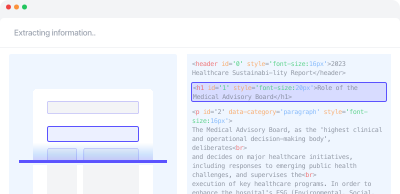
The ultimate product for transforming complex documents into formats that Large Language Models (LLMs) can seamlessly process.
0.6 page/s on average
5–10x faster than competitors
2,000 pages via Async API
Supported file formats
JPEGSupported
PNGSupported
BMPSupported
TIFFSupported
HEICSupported
PDFSupported
DOCXSupported
PPTXSupported
XLSXSupported
HWPSupported
HWPXSupported
Maximum file size
100MB (synchronous API) / 500MB (asynchronous API)
Maximum number of pages per file
Synchronous API: 100 pages (Files exceeding 100 pages are rejected with a 413 error)
Asynchronous API: 2000 pages
Asynchronous API: 2000 pages
Maximum pixels per page
200,000,000 pixels
(For non-image files, the pixel count is determined after converting to images at a standard of 150 DPI.)
(For non-image files, the pixel count is determined after converting to images at a standard of 150 DPI.)
Supported character sets (if using OCR)
AlphanumericInput and output
HangulInput and output
HiraganaInput and output
KatakanaInput and output
HanjaInput and output
Hanzi (Beta)Not fully supported
Kanji (Beta)Not fully supported
Hanja, Hanzi, and Kanji are writing systems based on Chinese characters used in Korean, Chinese, and Japanese writing systems. Despite sharing similarities, they possess distinct visual representations, pronunciations, meanings, and usage conventions within their respective linguistic contexts. For more information, see this article.
For best results, follow these guidelines:
- Use high-resolution documents to ensure legibility of text. Ensure a minimum document width of 640 pixels.
- The performance of the model might vary depending on the text size. Ensure that the smallest text in the image is at least 2.5% of the image's height.
- For example, if the image is 640 pixels tall, the smallest text should be at least 16 pixels tall.
Available Platforms
Versions
document-parse-260930
Released on 2026-09-30Alias: document-parse
This release includes the following updates.
- On
document-parse-260930,enhancedmode now uses an end-to-end vision-language model (VLM) parser in place of the previous multi-stage refinement pipeline, andautomode sends complex pages to this parser. Thedocument-parsealias now points todocument-parse-260930, soenhancedmode on the alias uses this parser. - For PDFs with a text layer (digital-born documents), text that the VLM parser recognizes is cross-checked against that text layer to reduce misrecognized characters.
- Richer HTML and Markdown output in
enhancedmode: heading levels<h2>–<h6>(depth insub_category),<ul>/<ol>lists, code blocks with their language, inline text styling, checkboxes, and line breaks within paragraphs. - Figure and chart captions in
enhancedmode are written in the language of the document's intended readers, which the model detects automatically. Korean, English, and Japanese are currently supported. - Inline equations within text are recognized in
enhancedmode and returned as LaTeX wrapped in$...$. - Improved recognition accuracy for block equations (the
equationcategory) inenhancedmode. - Improved table accuracy and stability on dense pages in
enhancedmode.
- Avaialble platforms : Upstage Console, On-premises ↗
Earlier versions, including deprecated ones, are listed in All models.
API privacy
Data not collectedUpstage does not collect any data from this API
- API input data is not used for model training.
- API input data is not stored, unless required for service delivery and explicitly stated.